
Comics
Follow a comic page: panels, speech bubbles and reading order
Trace panel groups, match bubbles to speakers and work through an ambiguous turn with a fully described three-panel example.
Published
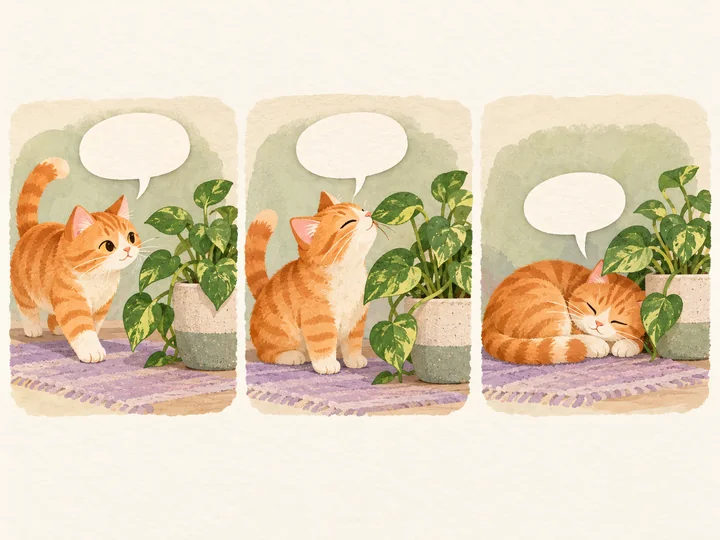
You may be able to read every speech bubble on a comic page and still lose track of who's talking or where to look next. Before reading it aloud together, take a moment to find the route through the pictures. Then follow the words and action within each panel.
The pictures carry parts of the story too. A page with only a few words can still ask you to follow several movements or changes of speaker. You can try the approach below with a comic you already own or have borrowed.
Find the first panel and trace the page
Check which way your book reads before choosing a starting corner. Many English-language comics run from left to right; many translated manga retain a right-to-left order. The publisher VIZ explains why that direction matters: it preserves the intended flow between panels and pages. Look for reading instructions in your edition, particularly if it opens at the opposite end from the books you're used to.
Now look for the separate pictures, called panels. A panel often has a border, though some pictures have none. The gaps between panels are called gutters. Notice whether those gaps divide the page into clear rows, a single column, or groups of different-sized pictures.
On a straightforward page with even rows, follow each row in the book's reading direction, then move down to the next row. For a left-to-right page, that means starting at the upper left, moving across, then returning to the left of the row below. For a right-to-left page, start on the right of each row. A single vertical strip leads you down through its panels.
Trace that route with a finger without reading all the dialogue yet. Keep your finger beside the panel so the picture stays visible. If one panel stretches across the fold, keep both pages open while you work out where it ends. Stop at any place where you aren't sure whether to move across or down; you can settle that turn before assigning voices.
Follow the words inside one panel
Once you've found the first panel, stay with it while you read its words and look at the action. There may be several kinds of text:
- Speech bubbles: Follow the narrow tail towards the speaker. It usually points towards their mouth. A tail may lead to the edge of the picture because the speaker is outside the panel, so don't give the words to whichever visible character is closest.
- Thought bubbles: A trail of small circles towards a character's head commonly marks an unspoken thought. You can read it aloud while making clear that the other characters haven't heard it.
- Captions: These are often boxes. They may give a place, a time or narration, but they can also carry a character's thoughts or speech from elsewhere. Read the wording before deciding whose voice to use.
- Sound effects: Lettering drawn into the action can represent a noise. Read or make that sound as part of what happens in the picture, rather than assigning it to a speaker.
These are common conventions, and individual artists vary them.
The order of bubbles within a simple panel generally follows the book's reading direction too. In a left-to-right comic, look for a path from the upper left towards the lower right. The arrangement of bubbles can lead you through a panel and across a page. Follow connected bubbles and their placement through the exchange. In a right-to-left manga, look for the corresponding path from the right. Read the English text inside each bubble in its usual direction.
The tail tells you who says the words; the bubble's position helps you find when to read them. Don't read everything said by one character before moving to the other. If their conversation goes back and forth, move between their bubbles in sequence. You can point to the speaker before each line until the exchange is clear.
Work through a turn that isn't clear
An uneven layout may offer two plausible places to look next. Here's an original, hypothetical three-panel page described in words. It has a left-to-right reading direction:
- Panel A, upper left: A character lets go of a ball.
- Panel B, directly below A: The ball lands in a puddle.
- Panel C, on the right: One tall panel sits beside both A and B. It shows another character reaching into the puddle for the ball.
The horizontal gap between A and B stops at the tall panel. A vertical gap separates the two-panel stack on the left from C on the right.
After A, moving straight across takes you to C. Moving down takes you to B. For this example, the intended sequence is A, then B, then C: the ball is released, lands, and is retrieved. Following A, C, B would put the retrieval before the landing. The left-hand stack and the action together give you a reason to go down before crossing to the tall panel.
On an actual page, look at the grouping, the trail of bubbles, any arrows and the action together. A tall panel alone doesn't settle the order, and stories can deliberately show events out of time order. If a reply seems to arrive before its question, return to the last clear panel and try the other route. See whether that route connects both the exchange and the pictures more clearly.
You can describe the movement as you point: down to the small panel, then across to the tall one. Once you've agreed on a route, read the short sequence again without interrupting it. If the page remains confusing, move back to a simpler page in the same book to see how it usually arranges panels and bubbles, then return to the difficult turn.
Keep the drawn action in the reading
A panel without words still belongs in the sequence. Pause long enough to look at it before moving on. It may show the action that makes the next line understandable, or a reaction after someone has spoken. You don't need to supply a sentence for every silent picture.
At a gap between panels, compare what changes. Follow the same character or object into the next picture; notice whether the place has changed or a caption names a later time. The comic may leave part of an action for you to connect. If the change is unclear, look back at the previous panel instead of jumping ahead to the next bubble.
For a first shared page, one person can read while the other follows the route with a finger. If you want to take different voices, agree which character each person will read and who will carry captions. Stay in the agreed panel order even when one character has several lines later on the page. Either reader can stop to point out a missed picture or speaker.
When you're ready for another comic, our books like Dog Man guide compares different kinds of comic stories and illustrated prose. For now, open one page together, find its first panel and trace where you'll go next. Read that page with its pictures included. On the next page, pause to trace any turn where you get stuck, then continue the story together.
Sources
- BookTrust: Graphic novels (comic-strip books) for beginner readers
- VIZ: FAQ, What Are Manga and Anime?
- Scholastic: A Guide to Using Graphic Novels With Children and Teens
- Nate Piekos / Blambot: Comic Book Grammar & Tradition
- Todd Klein: Balloon Placement
- Ohio State University Libraries: A Brief Introduction to Manga for Teachers, Part 2