Illustration
Start before the first page: reading picture-book endpapers
Find a picture book’s endpapers, compare one detail before and after the story, and check which opening and closing pages your edition includes.
Published
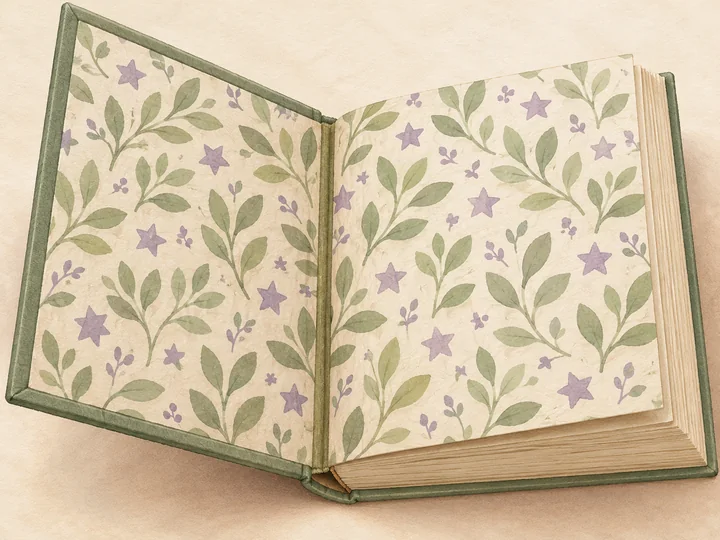
If you open a picture book straight to its title page and close it at the last line, you may pass over a picture that belongs to the telling. Look just inside the front and back covers. Sometimes those two places give you a beginning and ending to compare.
They can also be plain paper or a repeated decorative pattern. You don’t have to find a secret in them. The useful question is whether the particular pictures in your copy add something you can point to.
Find the inside-cover pictures
In a hardcover with endpapers, open the front cover and look at the paper joining the cover to the pages. One part is attached to the inside of the cover; the other can be turned like a page. There’s a corresponding place at the back. These are the endpapers, also called endsheets. PrintNinja’s construction guide describes the spread with one side glued inside the cover.
The endpapers aren’t the removable paper jacket wrapped around some hardcovers. If that jacket has flaps tucked inside the covers, lift a flap out of the way to see the paper beneath it. Nor is the title page automatically an endpaper: the title page carries the book’s title and creator credits and sits among the opening pages.
You may find more than one view as you turn the free endpaper. Look at what your book actually has rather than trying to match a fixed number of preliminary pages. Some bindings don’t have separate endpapers. You can still notice an illustrated inside cover, but there’s no need to hunt for an extra sheet that isn’t there.
Take one detail into the story
Before reading, spend a moment with the front endpapers if there’s something to look at. Notice a visible feature: a repeated object, a place, a character or a colour used across the spread. You can simply say what you’ve seen, then turn the page.
Keep a prediction separate from that observation. Seeing a row of boats supports saying there are boats in the picture. It doesn’t yet tell you who will sail in them or whether the story ends at sea. You can wonder about those things without announcing them as the answer.
The Carle Museum’s account of endpaper art describes how these pictures can extend a story or add visual and narrative information. That gives you a reason to include them in a reading. It doesn’t mean every front endpaper is a puzzle you must solve before starting.
If a child points to something else, follow that detail instead. You don’t need to agree on the most important object. What matters for the later comparison is remembering something that is actually visible.
Return to the back after the last line
When you reach the end of the story, turn through to the back endpapers before closing the cover. Look there first, then return to the front if you want to compare. You can move between the two views; you don’t have to rely on memory.
Choose the same feature in each place. Has an object appeared or disappeared? Is a character in a different position? Does the pattern stay exactly the same? Looking at one feature makes a small difference easier to describe than asking whether the whole spread has changed.
Here’s a hypothetical example, rather than a description of a published book. Imagine front endpapers showing an empty chair beside a table, and back endpapers showing the same chair with a coat hanging over it. The visible change is the coat. If the central story ends with a visitor arriving and putting down that coat, the back picture may carry the arrival a little further. If no such event happens, you have a changed picture, but less support for that particular explanation.
Try putting the connection into an ordinary sentence: the back picture shows this, and this part of the story makes me think it means that. Another reader might make a different connection. Return to the picture or the relevant story moment to see what supports each idea.
A matching front and back can be interesting too. A repeated object may be recognizable now because you’ve met it in the story. Or the endpapers may simply repeat an attractive pattern. Either is a reasonable thing to notice; a discussion doesn’t need an extra plot twist to count.
Use the endpapers in this copy
If someone remembers different endpapers in another copy, compare the actual books before deciding that a page is missing. A title can appear in several formats and editions, and the title alone doesn’t guarantee identical opening and closing pages. Our guide to board books and other formats explains what to check when matching editions.
An online cover image won’t show you these inside pages. If you specifically want the endpaper art you remember, look at an interior preview that includes it or ask which edition the other reader has. This isn’t a reason to replace a copy that already works for you; it helps explain why two copies may offer different things to compare.
For your next reading, start with the book you have. Open the front cover, notice one detail, and let the story give it context. At the back, see whether that detail has changed or means something different to you now. If it hasn’t, you can enjoy the design and close the book.